

In a recent Slate Podcast on Working, reporter Adam Davidson describes his predictions for what middle-class employment will look like in the years to come: “We are probably moving more to a project-based economy than a job-based economy, where rather than long-term, open-ended commitments, you have discrete commitments.” Instead of salaried employment, increasing numbers of professionals in this new economy will be paid to complete projects with clearly defined objectives, relying on the adaptability of their skills, their good reputations, and their willingness to turn their hands to new things. As Davidson puts it, those will do best who possess an ability “to switch gears very quickly,” embracing a certain amount of “chaos” and uncertainty in their careers.
In a recent Slate Podcast on Working, reporter Adam Davidson describes his predictions for what middle-class employment will look like in the years to come: “We are probably moving more to a project-based economy than a job-based economy, where rather than long-term, open-ended commitments, you have discrete commitments.” Instead of salaried employment, increasing numbers of professionals in this new economy will be paid to complete projects with clearly defined objectives, relying on the adaptability of their skills, their good reputations, and their willingness to turn their hands to new things. As Davidson puts it, those will do best who possess an ability “to switch gears very quickly,” embracing a certain amount of “chaos” and uncertainty in their careers.
For many American workers, the “project-based economy” (also sometimes called the gig economy) is already here. Think about the fast-expanding category of the self-employed: from freelancers and consultants to jobbing graphic designers and adjunct professors. Cobbling together a living from various sources, workers in a project-based economy must be responsive to a changing and sometimes unpredictable array of short-term job opportunities. But although the “project-based economy” is a new reality for members of the American middle class, it actually resembles the long-standing livelihoods of many urban workers in the developing world. In this economy, defined by Keith Hart in the 1970s as the “informal economy,” workers without access to stable employment create and trade petty goods and services outside state regulation and taxation. These types of informal enterprises were once expected to disappear as countries modernized. But now the informal economy is heralded as a crucible of entrepreneurial energy, exhibiting the kinds of flexibility and dynamism that formal institutions would be wise to emulate.
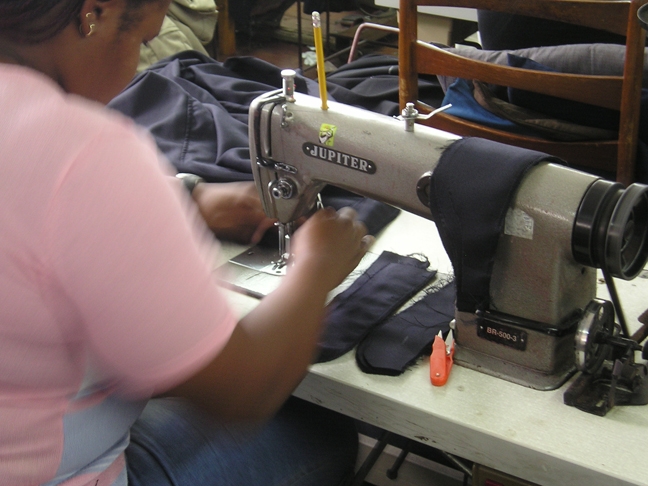
Among garment workers in Trinidad, a group with which I have conducted anthropological research since 2003, livelihoods can be described as increasingly project-based and decreasingly employment-based. Although the garment industry expanded in the 1970s with plentiful factory jobs, a recession in the 1980s and trade liberalization in the 1990s decimated the sector, and local producers now struggle to compete in the global market. As large factories have shut down, Trinidadian garment workers have taken up jobs in informal workshops and at home, supplementing their incomes with small projects for cash-in-hand payment, such as sewing school uniforms for neighbors, stitching garments for third-party contractors, or making costumes in local Carnival camps. Even workers with full-time jobs in the kinds of minimum-wage factories I describe in my book take up this kind of casual work to supplement their persistently low wages amid the rocketing costs of living.
The real question about the project-based economy is going to be, who controls it? What autonomy, power, or rights will workers have? A new UN study describes a worldwide shift from long-term employment to short-term jobs and warns of the desperation created by poor wages and chronic job insecurity. Scholarship in anthropology and sociology has seized upon the concept of “precariousness” to characterize this shift, highlighting that as working-class power has eroded and employment has become increasingly informalized and individualized, workers’ rights and entitlements have diminished.
My research with Trinidadian garment workers shows how complex workers’ feelings about the precarization of labor can be. Whereas on the one hand garment workers have the skills and knack to thrive in such an economy (as Davidson puts it, they can “switch gears very quickly”), they also mourn the loss of factory employment. When garment workers have secure jobs and the ability to top up their wages with small projects for private clients, they often relish the sense of excitement, unpredictability, and “being-your-own-boss” that comes from these informal economic activities. But when short-term employment relationships and cash-in-hand projects become their sole source of income, it creates overwhelming stress on the workers and their families, with the unpredictability of earnings affecting their ability to plan for the future.
We must be vigilant when hearing salutary pronouncements about a project-based economy that assume control will rest in workers’ hands. We must ask what kinds of regulatory and tax structures will underpin such a system and whose interests they serve. The ability to choose your own hours doesn’t mean much to workers who have to work flat out to meet their deadlines. The flexibility of making a living through several income-generating enterprises can become a constant hustle. Workers’ nurturing individualized relationships with several employers will require strong state institutions to regulate and adjudicate the protection of workers’ rights so that workers are not pitted against each other in a precipitous race-to-the-bottom. In a project-based economy, we will have to retool the institutions that have long protected workers—trade unions, occupational health legislation—to make sure that workers’ rights are not left behind.
Rebecca Prentice is a senior lecturer in anthropology at the University of Sussex in Brighton, UK. She is author of Thiefing a Chance: Factory Work, Illicit Labor, and Neoliberal Subjectivities in Trinidad. Her research on garment workers in Trinidad was funded by the Wenner-Gren Foundation, the Economic and Social Research Council (UK), and the Royal Anthropological Institute.


