
Feminist Technical Communication
Apparent Feminisms, Slow Crisis, and the Deepwater Horizon Disaster
Accessibility Tools


Teaching Technical Communication in the Twenty-First Century
2020 CCCC Best Original Collection of Essays in Technical or Scientific Communication
“[O]ffers important strategies for technical communication instructors, graduate students, and practitioners to incorporate cultural studies scholarship and social justice perspectives into their work. [P]articularly timely since it suggests ways to foster respectful, rigorous, and thoughtful discussions about the intersections of technical communication, diversity, and civic responsibility.”
—Ann Brady, Michigan Technological University
"The cultural dynamics of this century will continue to put pressure on the place, role, and function of technical communication. As our lives are enmeshed with the artificial, the algorithmic, and the global, there is no domain that isn’t a place of engagement. This book embraces the complexity of the present and near future and provides a rich and necessary playbook for design, research, and responsible communication. This book also gives voice to a new generation of scholars whose work is vital."
—Jeffrey Grabill, Michigan State University
“By attuning a generation of technical communicators, through the very ways they are taught to do their work, to worldwide social injustice on the part of hegemonic forces, Key Theoretical Frameworks works to readjust the field at large towards a new methodology of practices which understands and utilizes the globalized power of technical communication to make real change."
—Communication Design Quarterly
Drawing on social justice methodologies and cultural studies scholarship, Key Theoretical Frameworks offers new curricular and pedagogical approaches to teaching technical communication. Including original essays by emerging and established scholars, the volume educates students, teachers, and practitioners on identifying and assessing issues of social justice and globalization.
The collection provides a valuable resource for teachers new to translating social justice theories to the classroom by presenting concrete examples related to technical communication. Each contribution adopts a particular theoretical approach, explains the theory, situates it within disciplinary scholarship, contextualizes the approach from the author’s experience, and offers additional teaching applications.
The first volume of its kind, Key Theoretical Frameworks links the theoretical with the pedagogical in order to articulate, use, and assess social justice frameworks for designing and teaching courses in technical communication.
Contributors: Godwin Y. Agboka, Matthew Cox, Marcos Del Hierro, Jessica Edwards, Erin A. Frost, Elise Verzosa Hurley, Natasha N. Jones, Cruz Medina, Marie E. Moeller, Kristen R. Moore, Donnie Johnson Sackey, Gerald Savage, J. Blake Scott, Barbi Smyser-Fauble, Kenneth Walker, Rebecca Walton


Apparent Feminisms, Slow Crisis, and the Deepwater Horizon Disaster
A Practicum in a Book
Understanding Agency in Indigenous Translation and Interpretation through Indigenous Approaches to UX
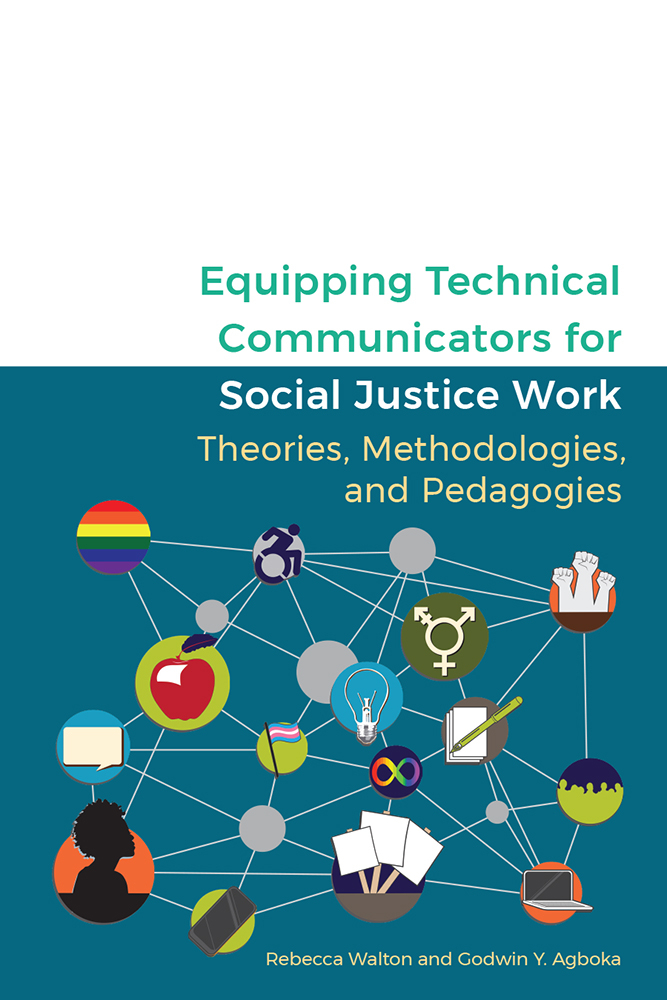
Theories, Methodologies, and Pedagogies

Rethinking Online Writing in the Age of the Global Internet


